Tell us about the job
Takes about a minute. No obligation.

A heat pump in Traverse County that needs repair has probably not been worn down by relentless weather pressure. 101 severe weather events were recorded in Traverse County, Minnesota between 2015 and 2024. That puts this county near the midpoint nationally, which means severe weather is a real but ordinary part of operating here. A contractor assessing a failed compressor or a refrigerant problem is not discounting the climate, but the load it represents is moderate enough that the likelier culprits are deferred maintenance, original installation quality, or a component that has simply run its years. The weather exists in the background of every repair call here. It is not usually the answer.
Stock built before the current generation of heat pump technology was even designed often runs systems whose internal components have no direct successor on a distributor's shelf. Half the homes in Traverse County, Minnesota were built in 1962 or earlier (2020-2024 ACS 5-year). A contractor who opens a unit in a house of that vintage has to establish whether the failed part is still in production, or whether a substitute exists that fits the existing refrigerant circuit and control wiring. That answer shapes the repair scope more than the fault itself does.
The Parts of a Heat Pump a Contractor Checks During Repair
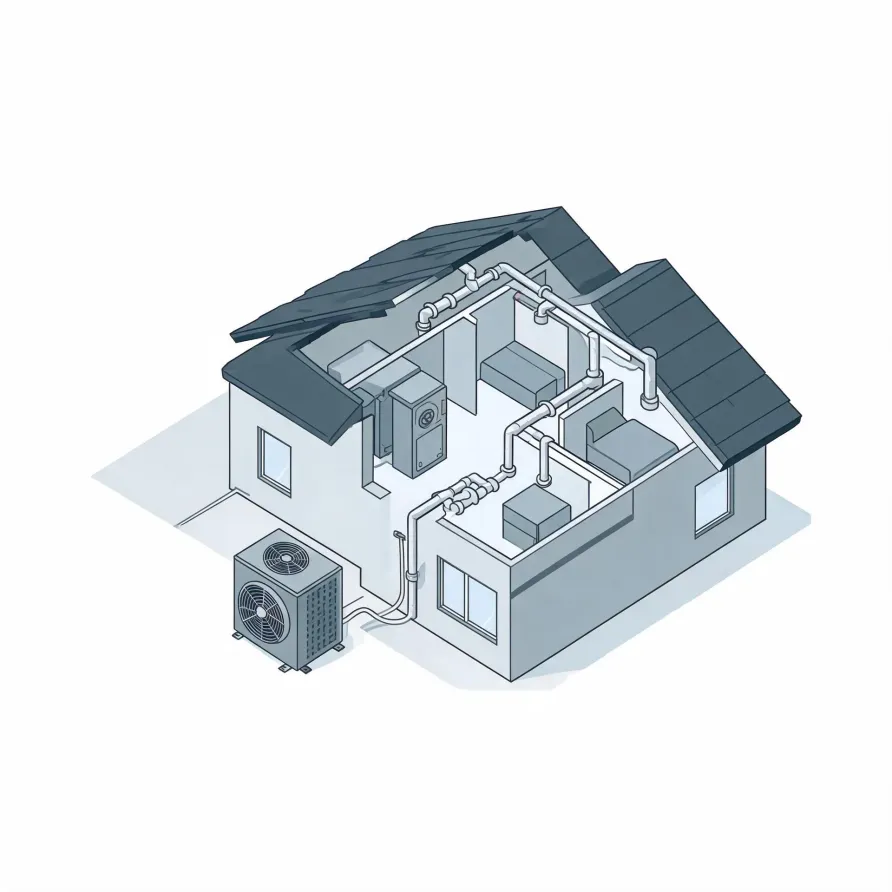
The outdoor unit is what most homeowners see first, a metal cabinet sitting on a pad beside the house that holds the compressor and the outdoor coil. The compressor is the part a contractor goes to early, since a heat pump that stops moving heat at all often traces back there. The outdoor coil, the fan motor, and the capacitor that starts the compressor are all inside that same cabinet and are common stops in any repair diagnosis.
Inside the house, the air handler holds the indoor coil and the blower that pushes conditioned air into the living space. A refrigerant line set connects the two units, and the reversing valve, which sits in the outdoor unit, is what lets the system run in either direction. The thermostat rounds out the picture, and a contractor checks it early when the complaint is that nothing runs at all.
The drawing shows a typical layout, and a licensed contractor determines which parts apply and what the actual condition of each one is in your home.
Get matched in Traverse CountyTraverse County, Minnesota, by the numbers
101 severe weather events were recorded in Traverse County, Minnesota between 2015 and 2024.
NOAA National Centers for Environmental Information, Storm Events Database, bulk CSV export, events 2015-01-01 through 2024-12-31.Half the homes in Traverse County, Minnesota were built in 1962 or earlier (2020-2024 ACS 5-year).
U.S. Census Bureau, 2020-2024 American Community Survey 5-Year EstimatesTraverse County, Minnesota holds 1,896 housing units (2020-2024 ACS 5-year).
U.S. Census Bureau, 2020-2024 American Community Survey 5-Year EstimatesOwners occupy 81.8% of the occupied homes in Traverse County, Minnesota (2020-2024 ACS 5-year).
U.S. Census Bureau, 2020-2024 American Community Survey 5-Year EstimatesCodes & Standards for Heat Pump Repair in Traverse County, Minnesota2 sourced rules and standards
Licensing and Legal Requirements in Traverse County, Minnesota
Minnesota defines a mechanical contractor as a business that installs, repairs or maintains heating, ventilating, cooling or refrigeration systems — the definition that carries the exemption from the residential contractor licence.
Minnesota's residential contractor licence does not reach HVAC work: the licensing section carries its own exemption list, and a mechanical contractor is exempt from the licence requirement by name.
Severe Weather Events in Traverse County
Extreme weather puts real strain on heat pump systems, which have to work harder and longer to hold a stable indoor temperature when outdoor conditions swing hard. How often that happens in your area shapes how much wear the equipment takes and how often repair needs come up.
101 severe weather events, 2015–2024. Source: NOAA National Centers for Environmental Information, Storm Events Database.